Τρίτη 7 Φεβρουαρίου 2023

Somewhere or anywhere?

  Are you a "somewhere", an "anywhere" or don't you think this is a valuable distinction? 

Do people have a choice in what they are?


Which question do you think is the most interesting in each pair? Check your understanding of the phrases in bold. Then ask and answer your questions in pairs.

1 a. Do you feel like settling down yet, or are you about to embark on a new adventure? 
  b. Do you think you'll stay put in one place or will you feel stuck if you do? 

2 a. Are you someone who plans ahead or do you tend to stumble into things? 
   b. What advice would you give someone who finds themselves at a crossroads in their life? 

3 a. Do you sometimes feel the need to get away from your current situation? 
  b What would be a backward step for you now? 

4 a What plans do you have? if they fall through, do you have a plan B? 
  b is life an uphill struggle at the moment? What would ease things for you? 

5 a. Are you someone that needs to stand out from the crowd? 
   b Are you happy to follow the crowd, or do you prefer to to do your own thing? 

6 a Do you see a bright future ahead for you or are you more pessimistic? 
   b. What's the next step in order to further your career?

HEDGING


Τρίτη 31 Ιανουαρίου 2023

What does your handwriting tell about you?

 Have you ever heard of graphology? What do you think about it? 

 This is what the American Psychology Association (APA) website supports: graphology n. the study of the physical characteristics of handwriting, particularly as a means of inferring the writer’s psychological state or personality characteristics. Graphology is based on the premise that writing is a form of expressive behavior, although there is little empirical evidence for its validity. Also called handwriting analysis. —graphological adj. —graphologist n.

Let's play a game. 
1. Sign off in a piece of paper
2. Watch the video
3. Discuss with your partner. Do you agree or disagree with the results?


How about discovering a little more about this art?
Read this article and share describing the different handwriting features

Now take a fun quiz to explore what graphology would say about your handwriting. 

Discourse markers add to one's fluency and working on using them can add significantly to the positive impression we make when discussing. 

Τρίτη 24 Ιανουαρίου 2023

Difficult Conversations (Part 2)

  Do you usually talk about problems with the people that are upsetting you?

What can happen if you don't?

Watch the video with social scientist, author, and famous speaker, Simon Sinek. What does he suggest?


COMMUNICATION SKILLS
If you are trying to encourage someone to change their behaviour, try this:

1. accept your part of the responsibility. eg. I know I didn't listen/ I shouted. ...and I'm sorry

2. describe the problem from your point of view as an observation, not an emotion. e.g. I notice that...

3. Avoid exaggeration and generalization. eg. You never...

4. explain why the issue is important to you. eg. It means that I can't...

5. describe your feelings without acting them out. eg. I feel upset when...

6. request a change. eg.  Would you be willing to...

What's the problem with these statements?
You never ever do the dishes!
Just turn the music down, ok?
I know you like playing video games but the noise is too much.


USEFUL LANGUAGE
I hope you don't mind me saying this, but...

I appreciate that you want to...and I ...

It would be really helpful for me if you could...

It's just that you could...which would allow me to...

Can I suggest something? How about...? 

OWN IT!
1. In pairs, decide on two annoying behaviours each one of you has that makes living together or next to one another difficult.
2. Individually, prepare to explain the problems to your partner without offending them. (Use the tips in communication skills and useful language).
3. Discuss aiming to find a solution

ACT IT OUT!
 Act out the conversation in front of the group. How well did the other pair give feedback? How could they have done better?

Τρίτη 17 Ιανουαρίου 2023

Difficult conversations

 Have you ever shared a flat with a housemate? What did you like/dislike about it?

If you had to rank these habits, how annoying would you say they are and why?
q. insist on thoroughly cleaning the flat twice a week.
b. Leaves a pile of dirty dishes in the sink.
c. Listens to very loud music until late.
Often invites friends round and has parties.
Spends most of the time in their room and rarely talks to you.

Watch this video of nightmare roommates and fill in the sentences
1. He's just ...... messy.
2. For example, he asks he_________ his roommate to buy him things.
3. The bathroom is ____ a mess.
4. I wish he________smoke in the house.
5. _____ she had people over once a week but it's three or more times.
6. If only he __________ the rent on time.
7. I _______ you didn't litter the bin with your hair.


PRACTICE
wishes

ON YOU
1. Write 5 things about other people that annoy you.
2. Share using so/such
3. Make a wish

AT HOME
4. How could you politely encourage your friend to change?
Think of possible ways to give temperate advice.

Τρίτη 10 Ιανουαρίου 2023

The camera never lies

How might these phots be fake?
Have you ever been misled by a fake photo?

READ the article quickly to find answers to the questions


1 Why is the advice 'You can't trust everything you read' not enough these days? 
2 In what ways is the 'deep fake' of Dalf different from a video of him from when he was alive? 
3 Why are beautiful fake images on social media especially dangerous to young people? 
4 Why can't 'the truth compete with lies'? 
5 What's wrong with some food 'hacks'? 
6 What is the main aim of the article: to describe, entertain or teach? How do you know?

VOCABULARY
Find the words in bold in the article. 
1. Which of the words in the line is an appropriate synonym for this context? 
2. Which of the words in the line is the red word the opposite of?

1. dedicated: committed, allocated, assigned disloyal
2. skillfully: expertly, deftly, adroitly clumsily
3. to alter: modify, develop, revamp stagnate
4. reveal: divulge, affirm. confirm, conceal
5. compete: contest, contend, fight surrender
6. generate: provoke, create, achieve prevent
7. grab: grip, seize, capture release

Let's play!


Τρίτη 3 Ιανουαρίου 2023

Saving space


What do you do to save space at home or at the office?
People can become very creative when they are pressed to find space.
For example, in this famous Bangkok market, Medlong, stall owners are required to move out of the way to let trains get through! Shoppers must stand to the one side to let train the pass. 


Read  these other ingenious solutions:
What are the advantages and disadvantages of each space-saving solution?
Could any work in your town or city? Why?
Which would you be happy to experience?


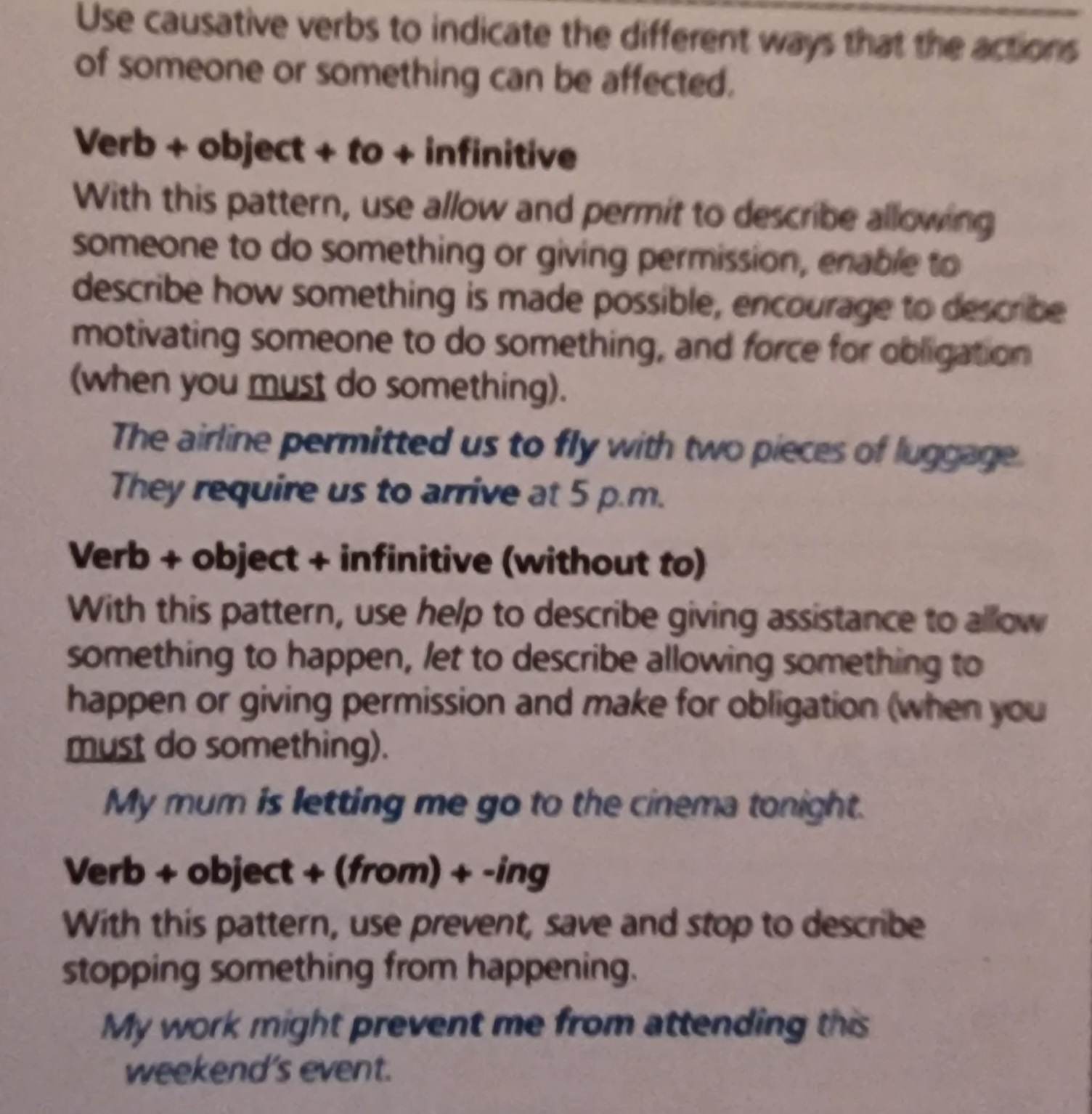
LANGUAGE: Causative Verbs


Τρίτη 13 Δεκεμβρίου 2022


 He's BAD enough: British double-amputee Chris Moon (51), competes in the Badwater Ultramarathon in Death Valley National Park, California. The 135-mile (217km) race, which bills itself as the world's toughest foot race, goes from Death Valley to Mt Whitney, California in temperatures which can reach 55 Celsius.

1. What makes this person success special?

2. Which of these things mean success to you? Put them in order from 1 (most important) to 8 (least important): Then discuss with your partner 

the ability to help others, the chance to travel, dealing with challenges, enormous wealth, inner peace and happiness, a lot of friends, a loving family, a rewarding career

Now, tell your partner what you would like to achieve personally 

a. this year

b. in a few year's time

c. by 2050


Read the following emails written by people to their future self. What can you guess about the writers?

What is the reason for writing them?


What do they expect to have happened?

What does each writer think they will be doing in the future?

LANGUAGE TIME
Check FUTURE TENSES here

and practice


Τρίτη 6 Δεκεμβρίου 2022

Informal and Formal English


Do you often need to use formal English? In what situations? 

The following sentences are a mix of formal and informal. What best applies,

INFORMAL or  FORMAL?

(a) The project will be completed next year. 

(b) I showed that his arguments didn’t hold water. 

(c) I wonder why he put up with those terrible conditions for so long. 

(d) Five more tests will be necessary before the experiment can be concluded. 

(e) It is possible to consider the results from a different viewpoint. 

(f) It has been proved that the arguments so far are without foundation. 

(g) He’ll have to do another five tests before he can stop the experiment. 

(h) It is not clear why such terrible conditions were tolerated for so long. 

(i) There are several reasons why the questionnaire should be revised. 

(j) We’ll finish the job next year


There are some basic differences in formal English and these include:

1. phrasal verbs vs latin verbs

2. colloquial expressions vs formal expressions

3. contractions vs full words

4. personal pronouns vs passive voice


Let's practice in the handout!


WRITING

What kind of formal writing do you need?

What do you usually concentrate on? This video focused on some distinct formal features of written language 


Ngo answered this advertisement

And wrote this letter. How formal/informal do you consider it to be? What makes it that way?


Look at this rather ...mishappen effort of a formal letter. Work with a partner to transfer it to formal language 


Τρίτη 29 Νοεμβρίου 2022

Narrating the past

 Remember the fast story we saw some time ago?

Well, here's the solution to what happened!


Today we have a final play with narrations.
Let's play a game ...but not yet.
Vocabulary practice first!

Now, select a paper and discuss an important moment of your life with a partner (p.216)

Let's practice our pronunciation.

Τρίτη 22 Νοεμβρίου 2022

Fixing misunderstandings

PAIRWORK

Think of misunderstandings you've had with people either in your own language or in English/another language. What happened? 

What were possible reasons?

  • the message relied on cultural information that the listener had no idea about
  • the message used vocabulary the listener didn't know
  • the message was disorganised
  • the speaker spoke too fast
Now watch the video. What do you think was the reason of the misunderstanding?


What's wrong with the message?
to the point, succinct, summarise, culture, start, clear, complicated, misunderstandings, disorganised
1. Messages need to be _____ , _____ and _________.
2. If a message is long and ______________, you could ask the speaker to _____________ it.
3. Information that is specific to your ______________ can cause _____________ if you don't explain it.
4. If a message is _________________, it might be necessary to _______ over from scratch.

Communication Skills
Fixing a misunderstanding
Simplify
  • The speaker can: identify the key information and repeat; check the listener has understood
  • The listener can check for a summary

Clarify
  • The speaker can: assume cultural knowledge will not be known; explain anything unique t their culture /language
  • The listener can ask the speaker to explain

Organise
  • The speaker can: signpost the order clearly; write or draw the instructions
  • The listener can ask the speaker to start over.


1. A. Let's meet at 8.
B. Sorry, I'm getting mixed up. Are you _________ eight in the morning?

2. A. So, in other _____ I think we should look at train prices before we book a flight.
b. Yes, that makes _______.

3. A. Ok, if I've been _________you correctly, this should be right now.
B. Let me see....No! You've got it the wrong way_____. This goes here and that goes there. 

4. A. Let me ________ it back to you. Out of the station, turn left. After 500 metres, second right into Broad street.
B. You've  ____it!

OWN IT!
Now think back to the misunderstanding you recalled at the start of the class. Use your new communication tools to fix it.

Τρίτη 15 Νοεμβρίου 2022

Travelling stories

 OWN IT- Be ready to present!

Think of three words or phrases or cultural concepts from your first language or another language. Be ready to present them to the class in the next lesson. you can include
  • a word or expression
  • a festival, dance, or celebration
  • a type of humour 
  • an important place that isn't well-known abroad
  • a dish that reflects the best food from home
  • an aspect of the national character that you want people from other countries to know about
  • a well-love TV show, film, or song that represents your country
TRAVEL STORIES
Do you like travelling? 


Read this funny story and underline the past tenses
The stories I had heard about hitchhiking were mostly shortcuts to getting murdered, so I hated the idea. However some friends persuaded me to give it a try when we missed our bus during a badly planned trip to Bosnia. 
The sun was setting when a truck slowed down in front of us. We pilled up in the back. The driver had no English and we didn'r speak his language but he kept repeating the word "Lavanda" in an ever louder voice. BY the time we arrived at our destination we were horrified!
As we were getting ready to escae he opened the trunk of his car. Ready he was going to murder us, we all screamed...
But no. None of that happened. Instead, he flashed a toothy grin as he unveiled his roomy trunk… Which was filled with tiny draw-string packets of dried lavender. Lavanda. Lavender.  All this time he had been trying to explain to us that he was a lavender farmer! “Lavanda!” he said for a final time and went off.  

Relieved and dazed, my friends and I continued our walk home, laughing to ourselves that we had just rode through Bosnia & Herzegovina with a baller lavender mogul. And true fact: he’s the reason why to this day, I still smile every time I see lavender.

NARRATIVE TENSES


Practice online here


Have you ever had an unexpected event happen during a trip? Tell your partner using each tense at least once